
Most businesses jump straight into marketing without stopping to ask a fundamental question: how big is the market we are actually trying to win?
Before you spend money on ads, content, or product development, you need to understand the size and shape of your market. These three metrics give you the clarity to set realistic goals, identify the right customers, and make sure your marketing is pointed in the right direction from the start.
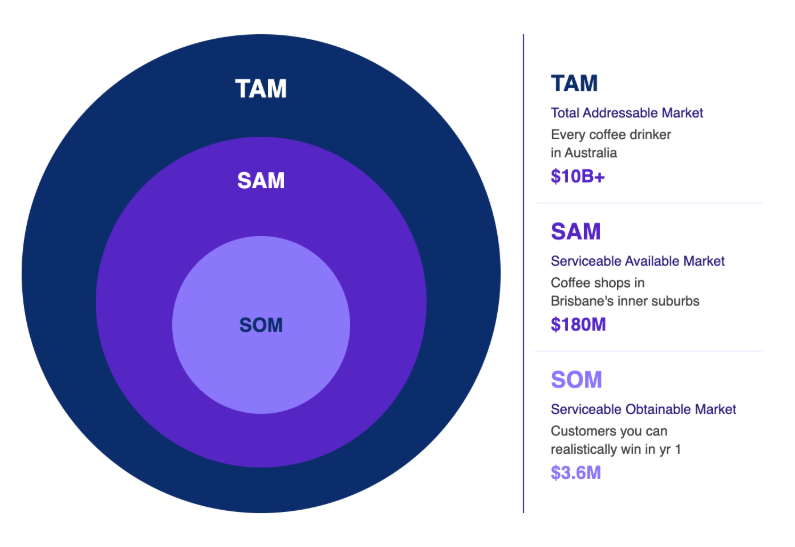
TAM: Total Addressable Market
TAM is the big picture. It represents the total revenue opportunity available if your business captured every single customer in the market for your product or service.
Think of it as a ceiling. It is the full size of the opportunity that exists, not what you will realistically win.
Formula: Total potential customers x average revenue per customer.
For an MSP offering IT support and cybersecurity, your TAM might be every small and medium business in Australia that needs managed IT services. At roughly 2.4 million SMBs spending an average of $8,000 per year, you are looking at a market worth billions. That is your TAM.
You can calculate it three ways:
The top-down approach uses existing industry research to estimate the total market size. The bottom-up approach builds from your own data, multiplying potential customers by revenue per customer. The value theory approach estimates the market based on the value your product creates for customers, rather than what they currently spend.
SAM: Serviceable Available Market
SAM is where you narrow things down. It is the portion of your TAM that your business can actually reach, based on factors like geography, industry, company size, or the specific problems you solve.
Formula: TAM x percentage of the market that fits your criteria.
Using the same example, maybe you only operate in Queensland and New South Wales and specifically work with professional services firms with between 10 and 100 staff. When you apply those filters, you are no longer talking about millions of businesses. You are talking about a far more specific pool, worth around $360 million. That is your SAM.
The best way to calculate this is from the bottom up. Rather than applying broad percentages to a big number, count the actual businesses that match your criteria. It gives you something defensible and useful.
SOM: Serviceable Obtainable Market
SOM is your realistic target. It is the share of your SAM that you can genuinely win within a specific timeframe, taking into account your competition, your capacity, and where your business is right now.
Formula: SAM x realistic market share percentage, based on your competitors, advantages, and growth assumptions.
Back to the earlier example. Your SAM is $360 million. You have a strong reputation in Brisbane, a team of 12, and a genuine edge in proactive security monitoring. Most established players hold around 8 to 12 percent market share. A growing business like yours might realistically capture 2 percent over the next 18 months. That gives you a SOM of $7.2 million — a concrete number to build your marketing plan around.
Why This Matters
Most businesses skip this step and jump straight into campaigns, content and ads without ever stopping to consider whether the market is worth pursuing in the first place.
Your TAM tells you whether the opportunity is big enough to be worth your time. Your SAM tells you exactly where to focus. Your SOM gives you a real number to plan around — one that reflects where your business actually sits right now, not where you hope it will be.
The businesses that get this right have better marketing, less waste, clearer messaging and a much stronger sense of which customers are genuinely worth going after.
If you have not mapped out your TAM, SAM and SOM yet, start there. Everything else gets easier once you know your market.